



White belt rashguard rules for No-Gi competition
You're a white belt preparing for your first no-gi BJJ competition? The first unpleasant surprise won't be on the mat, but at the weigh-in: your rashguard isn't compliant, and you're disqualified before even fighting. To help you avoid this, here is the official CFJJB 2024 regulations applied to white belts, with everything you need to know about the colors, cut, and material of your rashguard.
Why strict no-gi rashguard regulations?
In no-gi, the rashguard replaces the gi. It serves as the official uniform: it allows the referee to identify your skill level (your belt) and ensures visual fairness between competitors. The French Brazilian Jiu-Jitsu Commission (CFJJB) and the IBJJF have therefore defined precise rules for each rank. For white belts, these rules are deliberately simple—it's your first rank, and a sober, neutral outfit is required.
Specifically, a non-compliant rashguard = no fight. No referee will let you enter the mat, even if your registration is validated. And since the majority of new competitors get caught out by unfamiliarity with the rules, it's best to address this now.
Allowed colors for white belts
The CFJJB regulations are clear on this point: your rashguard must be predominantly white, meaning more than 50% of the garment's visible surface must be white. The only authorized secondary color is black, which must represent less than 50% of the surface.
In short, what is allowed:
• A 100% white rashguard
• A white rashguard with black inserts, sleeves, or logos (as long as white remains dominant)
• A rashguard with a brand or club logo, provided it is not too large
What is forbidden:
• Any other color (blue, red, green, dark grey, etc.)
• A black rashguard with white inserts (the ratio is reversed)
• A rashguard with colored patterns, camouflage, or tie-dye
This rule exists for a simple reason: at the white belt level, you are just starting your journey. Sobriety is key, and the visual identification of your rank by the referee must be instantaneous.
Rashguard length, cut, and material
Beyond colors, the CFJJB regulations impose technical constraints on the rashguard's cut:
• Elastic material: the fabric must be stretchy and compressive, not a classic cotton t-shirt
• Close-fitting: it must be tight to the skin, without flapping
• Sufficient length: it must cover the waistband of your shorts, without showing skin on your stomach or back when you raise your arms
Regarding sleeves, you have the choice between long-sleeved or short-sleeved rashguards. If you're still undecided, we've written a complete guide on long-sleeved or short-sleeved rashguards to help you decide based on your body type and competition season.
What about the shorts?
A compliant rashguard is not enough: your shorts must also comply with the regulations. For white belts, shorts must be all black, all white, or a combination of black and white. No pockets, no zippers, no plastic or metal parts. The length must reach at least mid-thigh (maximum 15 cm above the knee) and not extend beyond the knee.
If you're looking for a reliable reference, the Competitor V2 set from Hustle Fightwear is CFJJB and IBJJF approved. Hundreds of competitors have already competed with it in official championships. You can find all models in our rashguard collection.
The most common mistakes for white belts
Here are the pitfalls that cause white belts to be rejected at weigh-ins:
• The colored training rashguard: you have a great one you love, but if it has red, blue, or a pattern, you won't be able to compete with it.
• The compression t-shirt for weightlifting: even if it's white, check that it's stretchy and designed for combat sports—some fabrics won't withstand a single leg attack.
• The overly conspicuous logo: a large sponsor on the chest can be enough to get the outfit rejected. Keep it simple.
• The too-short rashguard: no one says anything during training, but in competition, the referee checks that the bottom of the rashguard properly covers the waistband of the shorts.
To go further, also read our article on the complete no-gi outfit and CFJJB regulations, which details all belts and all pieces of equipment.
In summary
For your first no-gi white belt competition, remember three rules: your rashguard must be predominantly white (more than 50%), only black is allowed as a secondary color, and it must be made of elastic material, close-fitting, and long enough to cover your shorts. Invest in an approved outfit like the Competitor V2 from Hustle Fightwear and you won't have to worry on competition day. Good luck with your competition.
Read more
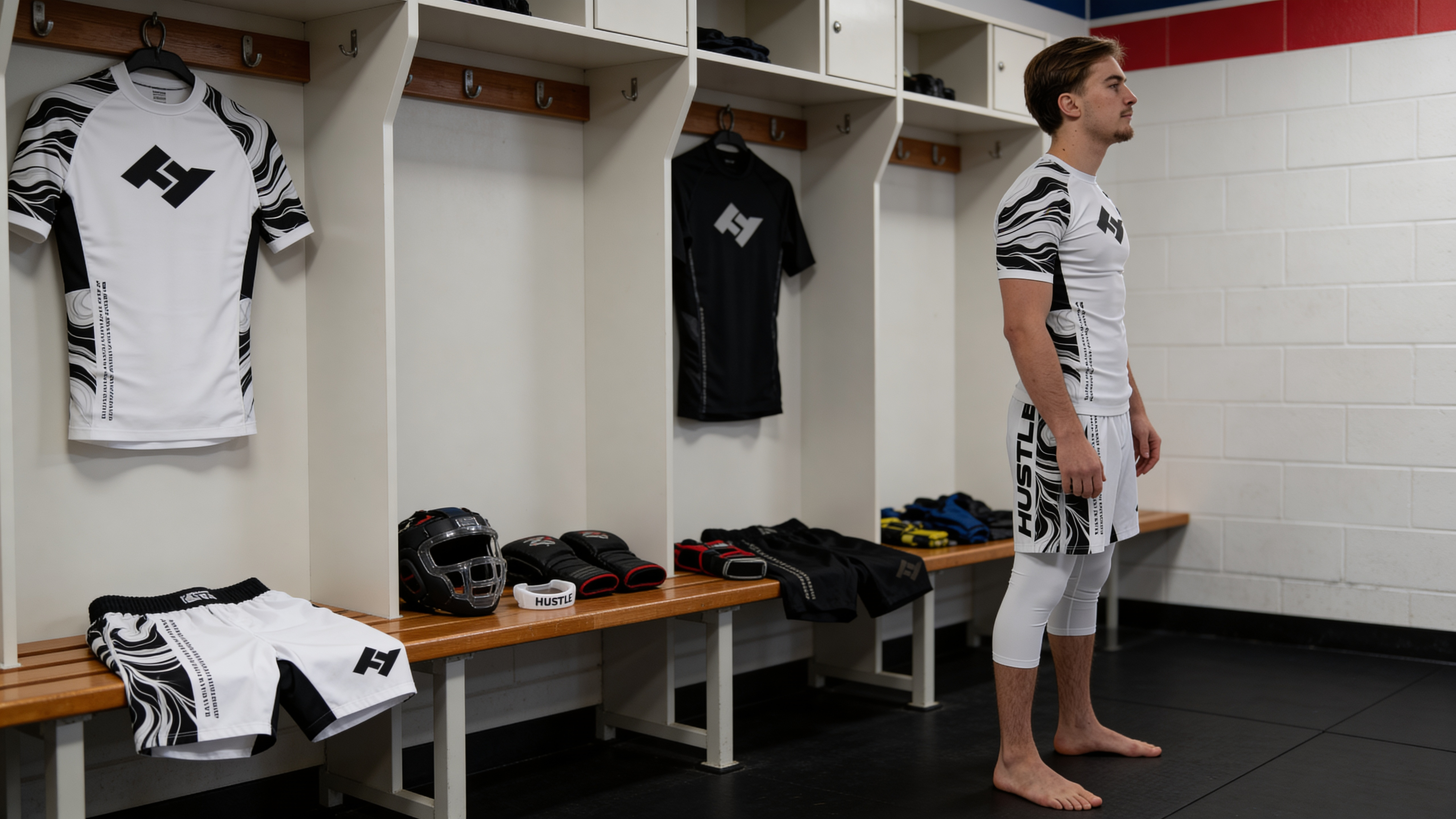
Do compression shorts belong on the grappling mats? We review their advantages, limitations, and alternatives.
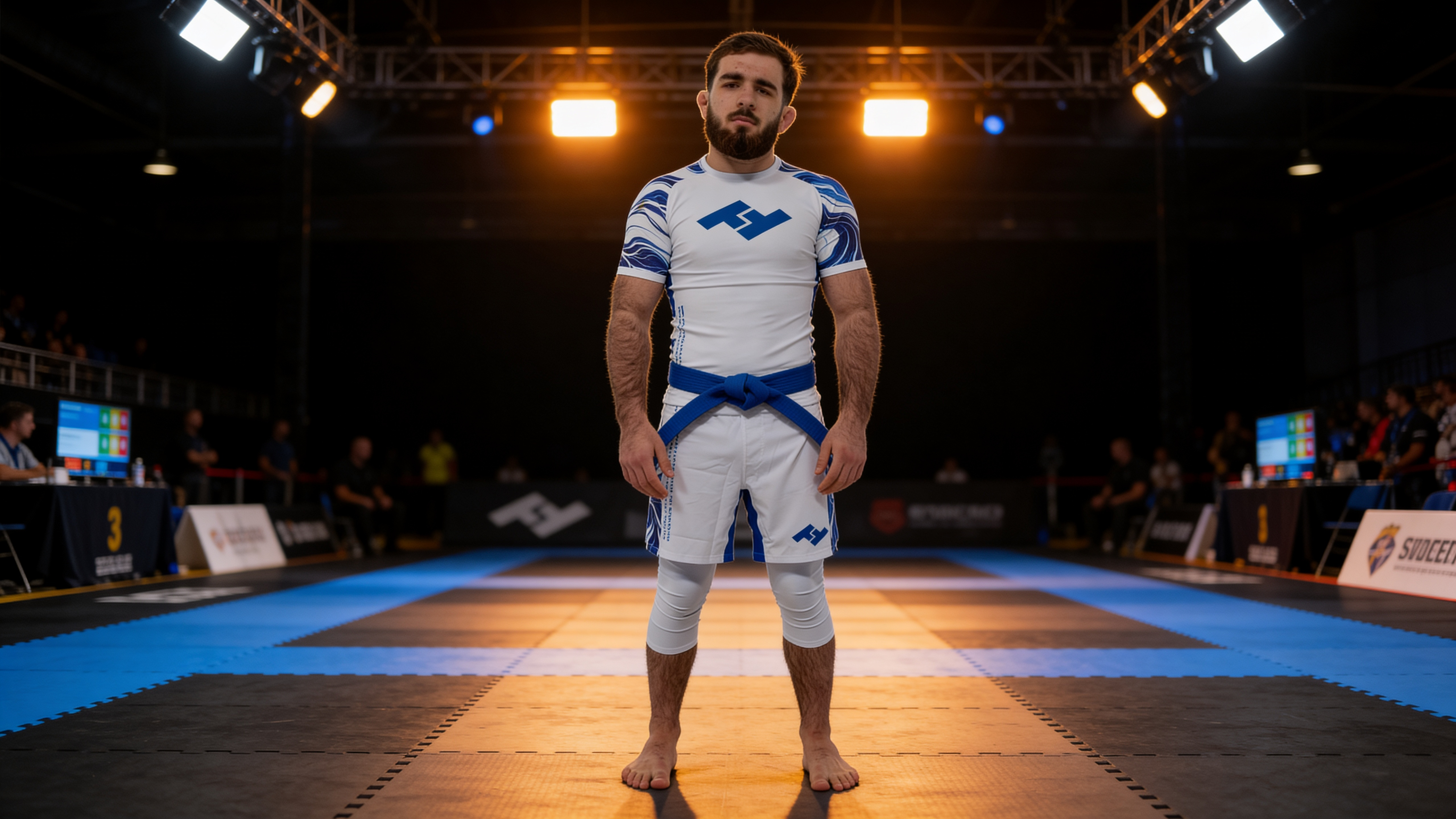
The complete guide to blue belt rashguard regulations in no-gi competition: authorized color percentages, cut, length, and CFJJB and IBJJF approved attire.