

Which rashguard to choose for BJJ in 2026? Complete Buying Guide
Choosing a rashguard for BJJ or grappling isn't just about style. It's a technical choice that impacts your comfort, performance, and even your longevity on the mat. There are real differences between fabrics that hold up to friction, cuts that don't ride up during a guard pass, and seams that survive three seasons of competition. At Hustle Fightwear, we manufacture rashguards designed for French competitors — here are the criteria that really matter for finding the best BJJ rashguard suited to your practice.
The fabric: the foundation of a durable rashguard
A good rashguard is judged first by its feel. Most high-performance models combine polyester and elastane (spandex), usually in an 80/20 or 85/15 ratio. Polyester provides resistance to repeated friction — essential when you spend 2 hours doing randori a week — while elastane provides the elasticity needed for explosive movements.
The grammage is an often overlooked indicator. A fabric between 220 and 260 g/m² offers the best compromise between hold, compression, and breathability. Below that, the fabric becomes transparent when stretched; above that, you sweat as if in a sauna. For no-gi grappling in particular, opt for a fabric with an anti-odor treatment: it's a detail that makes all the difference after several training sessions a week.
The cut: fitted but not suffocating
A BJJ rashguard should hug the skin without compressing you. If you can pinch it between two fingers and there's more than 2 cm of slack, it's too loose — your opponent will grab it during a guard pass. Conversely, if it cuts off your breathing or marks your skin after 20 minutes, the size is too small.
Also check the torso length: a good rashguard goes below the belt and should stay in place when you raise your arms. Models with a silicone band inside the bottom hem solve this problem once and for all. To help you find your size, consult our rashguard size guide.
The seams: where rashguards break down
This is the number one weakness of low-end rashguards. Classic seams give out after a few months under repeated pulling. Look for models with flatlock seams and, ideally, reinforced zigzag stitching on tension areas: armpits, collar, bottom of the torso. Flatlock seams also have the advantage of not irritating the skin during ground transitions.
A detail that reveals a good rashguard: the collar. A collar sewn with a reinforced inner yoke will not deform after 50 washes. A simple collar, on the other hand, will end up wavy after three months.
Long sleeves or short sleeves?
This is the classic dilemma in BJJ. Long sleeves better protect against mat burns and are mandatory in some federations for competition. They are also more comfortable in winter and offer slight compression on the forearms, useful for practitioners who use their grips a lot.
Short sleeves, being more airy, are suitable for summer training, MMA, and practitioners who prefer to have their arms free. For a detailed choice depending on your discipline, we have written a dedicated article: long sleeve or short sleeve rashguard, which to choose.
Competition approval: what to check
If you plan to compete in CFJJB or IBJJF no-gi, your rashguard must adhere to strict rules. For example, for a black belt, a minimum of 50% of the fabric must be black, with limited red. Each belt color has its own constraints. Hustle Fightwear rashguards are designed to comply with these regulations — notably our Competitor V2 model, CFJJB and IBJJF approved, with an anti-slip band at the bottom hem and reinforced flatlock seams.
A non-compliant rashguard can lead to your disqualification on the day of the competition. That's why we recommend investing in a competition model as soon as you're aiming for the podiums, even as a white belt.
Our final recommendation
To summarize: opt for a polyester/elastane rashguard of 220 to 260 g/m², with reinforced flatlock seams, a fitted but not compressing cut, and a silicone band at the hem. If you compete, check for CFJJB/IBJJF compliance. You can discover our complete range on the Hustle Fightwear rashguard collection — all our models are tested by our ambassador athletes on the mat before arriving in stores.
A good rashguard is an investment of 40 to 70 €. Well chosen, it will last you 2 to 3 seasons without complaint. Poorly chosen, you'll buy it again in 3 months.
Read more
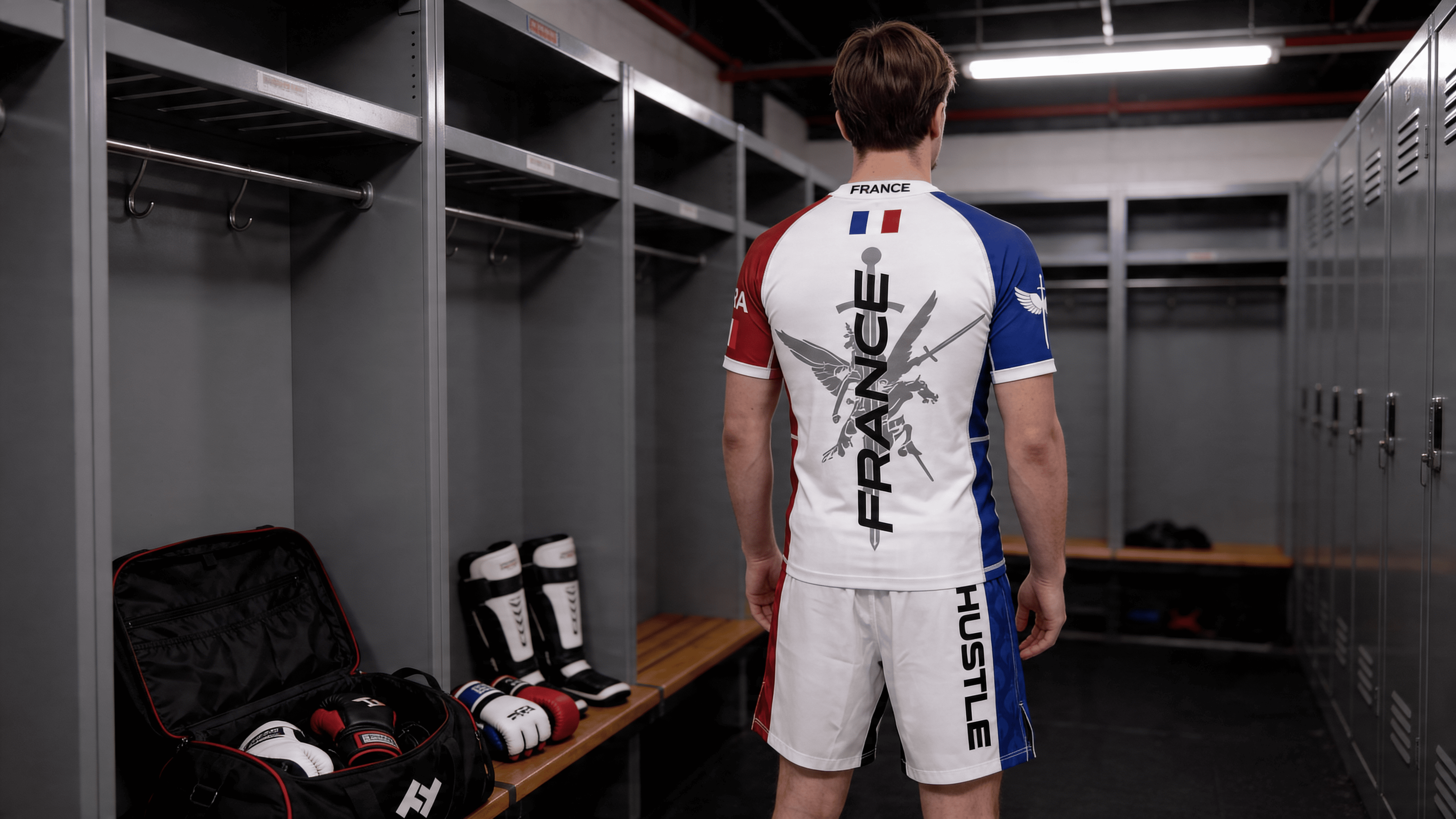
The complete list of equipment to start MMA: gloves, rashguard, shorts, mouthguard, shin guards, and essential accessories.
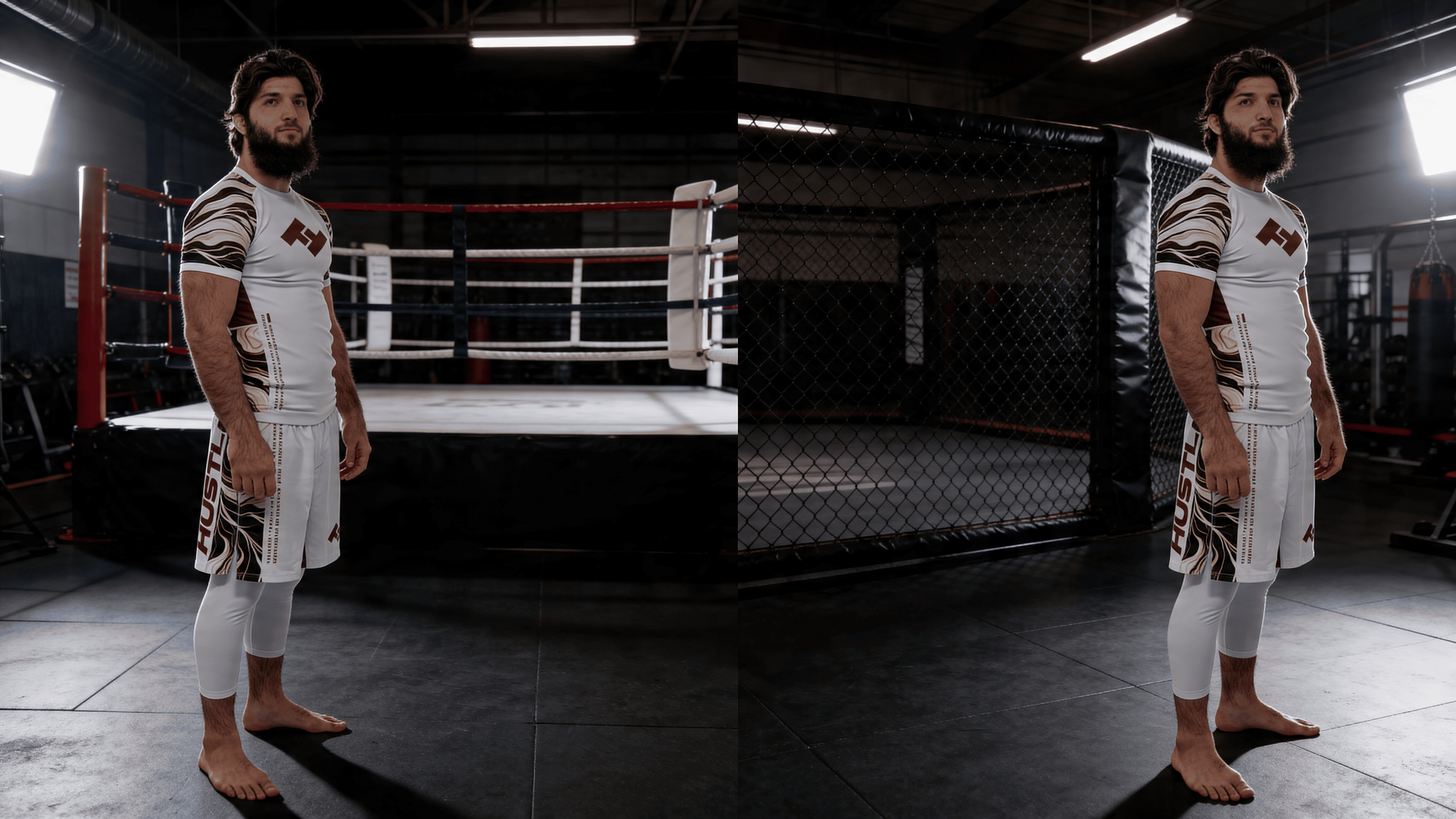
Hesitating between MMA shorts and boxing shorts? Cut, material, length, closure: we review all the differences to help you choose the one that truly suits your discipline.